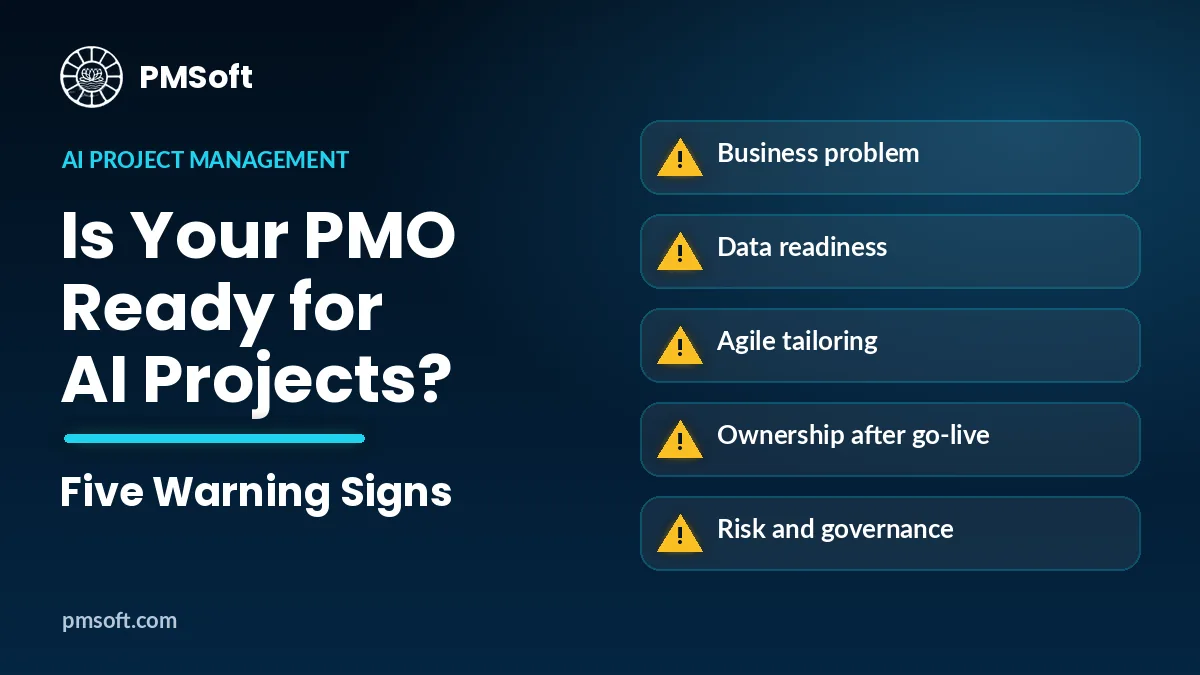
Is Your PMO Ready for AI Projects? Five Warning Signs
Most organisations now have at least one AI initiative under way. Many of these are managed in the same way as any other IT project: a charter, a plan, a set of stage gates and a launch date.
That approach works well for an ERP rollout. It works less well for AI. AI projects depend on data that may not be fit for purpose, produce results that are probabilistic rather than fixed, and need clear ownership long after go-live. When a PMO treats them as conventional projects, the early warning signs are easy to miss.
Here are five signs that your PMO may not yet be ready for AI projects, and what good practice looks like in each case.
1. AI projects are approved without a clear business problem
Many AI initiatives begin with a technology (“we should use generative AI”) rather than a business problem with a measurable outcome. Without a defined problem and a measure of success, there is no sound basis for deciding whether a project should continue, change direction or stop.
What good looks like: every AI project starts with a stated business objective, a baseline and an agreed measure of success.
2. Data readiness is assumed, not assessed
In conventional projects, data is usually an input that already exists. In AI projects, data quality, availability and usage rights often determine whether the project is feasible at all. Problems discovered late lead to delays, rework or abandoned pilots.
What good looks like: data sources, quality and permissions are reviewed before significant development begins.
3. Agile practices are applied without tailoring for AI
Many delivery teams apply standard agile practices to AI work: fixed-length sprints, story points and a definition of done based on completed features. AI work is more experimental. Data exploration and model training rarely fit neatly into a sprint, and a feature can be “done” while the model is still not performing well enough.
Without tailoring, teams report progress on activity rather than on results, and stakeholders receive a misleading picture of where the project stands.
What good looks like: agile practices adapted for AI, with time-boxed experiments, clear hypotheses, and a definition of done that includes model performance and business readiness.
4. No one owns the system after go-live
Once an AI system is live, its performance can change as data and conditions change. If ownership ends at project closure, no one is responsible for monitoring results, handling incidents or deciding when the system should be retrained or retired.
What good looks like: a named business owner and an agreed monitoring arrangement are in place before the project closes.
5. Risk and governance are left to legal or compliance teams
Questions about fairness, transparency and the impact on people are often handled as a separate compliance exercise at the end of a project, when changes are most expensive. With regulation such as the EU AI Act and standards such as ISO/IEC 42001, clients increasingly expect these questions to be addressed during delivery.
What good looks like: impact and risk assessment are built into the project lifecycle, with the PMO coordinating them.
Why this matters for the PMO
None of these issues is primarily technical. They concern governance, decision-making and accountability, which are precisely the areas a PMO is responsible for.
A PMO that adapts its methods for AI can help the organisation move more pilots into production and avoid costly failures. A PMO that does not adapt risks becoming a reporting function that tracks AI projects without influencing their outcome.
Where to start
If two or more of these signs are familiar, a structured assessment is a practical first step. It shows where your current processes, skills and governance stand, and which gaps to address first.
PMSoft’s AI Readiness Assessment evaluates how prepared your organisation and PMO are to deliver AI projects, covering strategy, data, delivery practices, governance and skills. You receive a clear view of your current position and a prioritised set of recommendations.
Next step: take the AI Readiness Assessment or speak with us about your AI projects.
Written by Ravindra Gajendragadkar, PMI-CPMAI, founder of PMSoft.